Jacob Laqua Jacob Laqua

DL-021 ∞ CHROMBUS, CHROMBos, chronOS

August INURBIS Devlog covering CHROMBUS dialogue, targeting system unification + lock on in scanning mode, September plans (CARD system + immsim expansion)

Hey y'all,

I'm tired, but CHROMBUS is talking now. They now give running commentary on what you're doing, whether that's where you are in the story or what you're focused on right now. There are many lines of dialogue and animations, and we’ll keep adding more. To make it all work, I built a unified targeting system that tracks the player's focused target across both FPS and scanning modes. That also meant reworking the cloneling's targeting, since your weapon can now lock onto the selected target while you're scanning. Targeting is more than just aiming weapons and abilities, but understanding who or what the player is focused on and having the entire set of systems understand that. Nice.

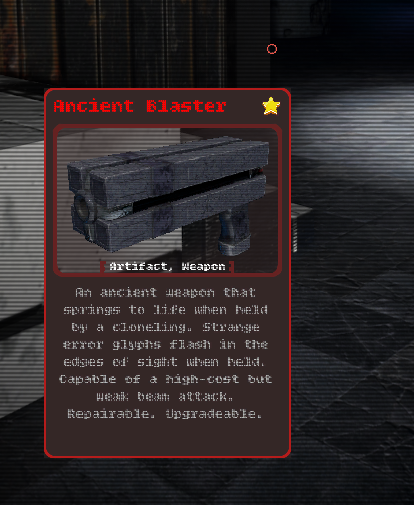
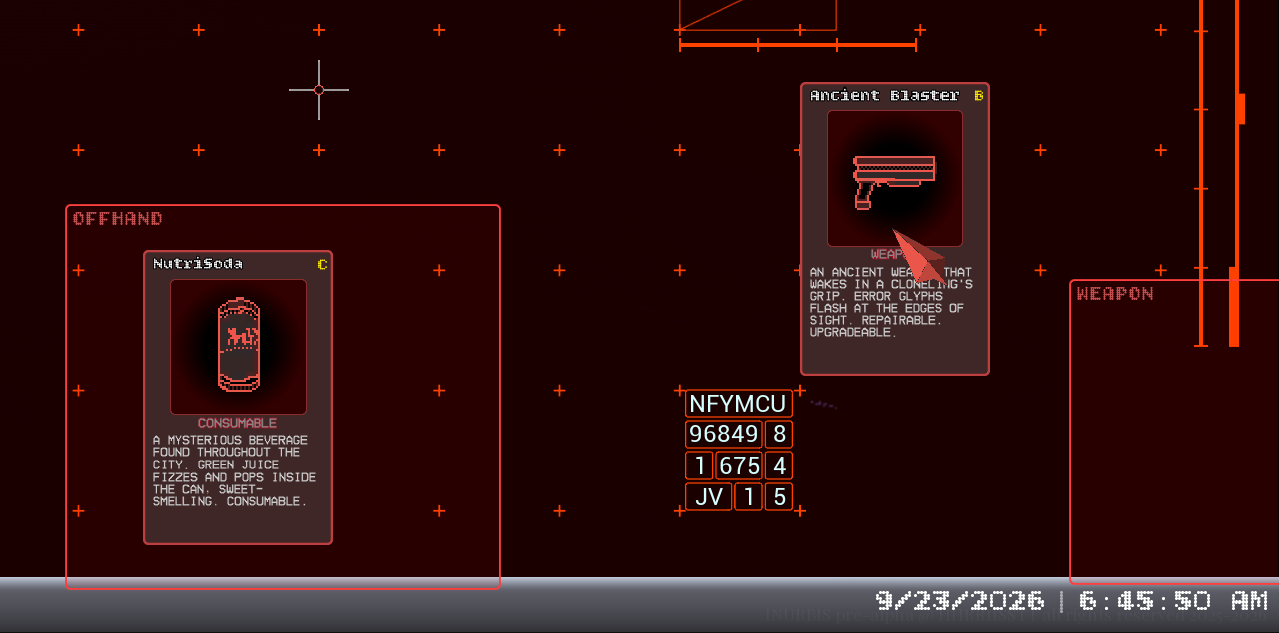
I want INURBIS to be fully playable as a straight first-person-action-immsim-RPG game, or by leaning on the scanner and running all your commands there in a sort of tactical "turn-based" mode. The game is real time with time dilation, but calling it that is a mouthful. It's closer to say it plays in an RTWP-adjacent sense of strategy and "turns." So what's a turn in a real-time game? For now, turns boil down to the current resources (LIFE/HLTH/ENRG/STRS) the player as access to at any given moment. ENRG is the clearest limiting resource, since it powers your first weapon, the Ancient Blaster. Diegetically it's the cloneling's energy, but design-wise it works as a hybrid: active time battle bar + action points + stamina meter.

The game is also balanced around that concept. I want the challenge in the game to be about learning about the environment and the enemies, and applying the "correct" solution to dealing with them - if not, things should get hard, fast. I want each enemy to have some capability to checkmate the player situationally; so the challenge posed should be one that is surpassed by making the right choices, and that the type of challenge is not necessarily something you can slow-mo-combat your way out of. Right now, scanning is free. But in the future, it will likely incur a minor STRS (stress) cost.

But what does "playable as both" really mean? Every action can be manually triggered and manually aimed, or you can use the scanner to lock onto targets, run actions, and eventually queue those into a sequence. Unlike Fallout's VATS, where you're limited to shooting enemies, I want a system that also covers a wide range of non-combat and combat-adjacent actions. Instead of a sequence like "shoot enemy 1 in the face, then shoot enemy 2 in the arm," I want to support sequences more like "stun the ranged enemy by shooting a barrel, turn and flip the switch, then switch to the sword and attack the close enemy." You can also take movement actions (turning, jumping, crouching, etc.) while scanning. My hope is that this lets players freely style their actions in a way that's more conducive to holistic roleplaying, rather than strictly being a game about shooting enemies.

Next month's work is exciting, and covers two things: 1. the CARD system, and 2. adding more purposeful immersive sim mechanics. The CARD system design is finally done, meaning I've fully clarified the rules for how the player interacts with CARDS. This adds new strategic layers to combat, plus a rudimentary form of inventory management. My big goal is to distill roleplaying choices about character building and inventory down to the simplest mechanical decision possible: do I, as a player, want this card or not? Taking a card covers the entire gamut of RPG mechanics. What is my cloneling doing? What do they have? What are they wearing? How has the nature of their being changed? What issues are they dealing with? It should all be in the CARDs :)

All of this has to work with the kinds of mechanics people expect from immersive sims, so I needed a clear system to carry that intent. A lot of it is spurred by one idea: using food to bait slimes and manipulate their behavior. I could have added a quick "throw this mushroom, throw this soda can" on top of what I've already built, but in an immersive sim, shouldn't you be able to throw any object? Deus Ex does this, but I want to tie it in more purposefully and make throwing, lifting, and moving objects a celebrated mechanic in its own right. That means building a new layer to marry those mechanics with the card system and everything I've already built around items and weapons.

On the backend, I'm starting to formalize some of the gameplay into permanent system architecture, which is exciting. I can feel the ring of player-centric gameplay elements closing to form a whole, one that will complete the pre-alpha phase of development. I'm having a good time refactoring.

The scanner and the operating system are going to carry a lot of future systems, which makes them more important than they might look right now. They quietly hold up… the stuff that is coming. For now, though, I care more about communicating the kind of game INURBIS wants to be, and sharing enough of that vision to spark imagination. We're not there yet, but I'm starting to see the light at the end of the tunnel, and I think the demo will be a good showcase of that. The demo will come during / after the closed alpha playtest.

I'm really looking forward to formally closing the first phase of development and starting on the hybrid procedural level generation and settlement + NPC gameplay. Soon enough.

Thank you

HHRRIISSTT

Read More
Jacob Laqua Jacob Laqua

DL-020 ∞ Keybindings, ATD, scanning mode, intro cinematic

Hello friends,

It has been a very productive July. I lied in the last devlog, and ended up completing keyboard + mouse customizable keybindings early this month. Controller support still isn’t started, but I’d love to get it done in time for the closed pre-alpha playtest. A lot of my efforts lately have been making everything ready for the playtest, lots of system polish is happening between new features.

On the new feature front, Active Time Dilation and Scanning Mode are alpha complete. I’m very excited about these features and I wasn’t sure I was going to get them in for pre-alpha. I managed to get multiple heavy work sessions in this month, but also spent a lot of time and effort up front researching and planning the right implementation for these features. Also, I think all my time daydreaming about INURBIS counts as development time. Put that way, it’s practically a full time project. Okay, maybe not really. I am on the daily crushed by my day job doing EXTREME PROGRAMMING (help)!

Active Time Dilation is a fun mechanic. In INURBIS, time dilation is practically an elemental force in The City at the End of Time, and an important factor for the setting, lore, story, and gameplay. Nature has been all but replaced as the primary scaffolding of life, but it would be valid to say that time’s ebb and flow waxes and wanes “naturally”. What this means in game mechanics is that time dilation can occur for many reasons, triggered by the world, player, enemies, or even by CHROMBUS.

All of which adds a lot of complexity to programming a solid implementation. Every call to the ATD system passes in variables governing how the player experiences that specific instance of time dilation. This means that the cloneling can “ride along” with the time dilation, moving at their normal pace while the world is slowed, and vice versa. This also means that time dilation can occur at any time, meaning I needed to build in a system that could handle multiple concurrent time dilation requests. This works by using a hybrid multi-layered priority and queue system.

The cloneling is equipped with a Active Time Dilation sensor (seen in the top of the screen while the scanner is active in below video) communicating to the player when the flow of time is interrupted against the player’s local temporal resolution. That is to say a nice little widget pops up on the screen notifying the USER when the tides of time have become choppy.

The largest use case for active time dilation is the newly added Scanning Mode. I am still building the components of the game using an MVP strategy, so with that in mind scanning mode is setting up a few future features as well as providing the player with information on INURBIS, specifically devices, enemies, and objects. This was… surprisingly fun to develop, especially the entity selection logic. For an overview of how I’m thinking about scanning mode, you should reference things like V.A.T.S. / Pip-Boy from the Fallout series, and the ATB system from Final Fantasy VII Remake.

Entering scanning mode switches the input to something resembling a desktop computer, though the player can still move, jump etc. The entire diegetic player character menu system will be built on top of Scanning Mode, with applications like managing your cloneling’s loadout, viewing their stats, configuring upgrades. In the near future, expect some of the next abilities in the game specifically made to be used from scanning mode.

I want to leverage ATD and Scanning Mode in a few ways against the larger game design. V.A.T.S. did something very cool in regards to helping players who maybe feel they aren’t the best at first person shooters to play a character who is very good at shooting. Similarly, I hope that players will leverage ATD / Scanning as a very powerful tool to help them slow down and think tactically about how to navigate difficult situations.

The player can attack from scanning mode, and currently there are no limits to how long the player can stay in scanning mode - however the player’s ENRG reserves do not recharge any faster while time is dilated, meaning that the core number of actions the player can take is still limited by their cloneling’s stats / loadout.

My working plan is to balance the game around creating what are difficult encounters that are made easier with ATD for players that want to slow down and consider options in what is ultimately moving the game towards a hybrid action “turn based” design, wherein “turns” represent the number of actions your character can take per X unit of time. It’s my hope that this will increase accessibility to the game, coming from someone who has a lot of neurological health issues which are slowly making games harder and harder to play!

I may add costs and consequences to the cloneling when using scanning mode in the future, such as increasing the cloneling’s stress the longer scanning mode is active. I think this fits the setting well, as ultimately processing the increased amounts of data during dilated time should put stress on the cloneling’s hybrid computer brain module. I’m working towards making all the elements diegetically cohesive, the story requires it.

As always, everything shown is work in progress, subject to change. I probably will not release the intro cinematic in it’s entirety or finished form in devlogs etc. I really need to get better at waiting to show things lol

I’ve also started work in earnest on the intro cinematic. I’m really excited for this, working with pr4nta again who also helped design and animate CHROMBUS! (There are many CHROMBUS animations) We’ve got the first pass / proof of concept scene fully animated in 2.5d.

I’m very excited for this and will do my best to get it done for the playtest. This cinematic establishes some historical events of significance to the main quest of the game! You may also note that this cutscene is in pixel art? I hope some players will consider why some elements are in pixel art while the game world exists in 3D (puzzle box narrative incoming).

Thanks for reading, see you next month!
HHRRIISSTT

Read More
Jacob Laqua Jacob Laqua

DL-019 ∞ PLAYTEST #1 DATE, SETTINGS, CITY SECURITY NETWORK

it’s blastin’ time

Hello friends,

I spent about 1.5 weeks this month traveling. Some of our family were very generous and took us on a vacation, and we also celebrated my partner completing their master’s program. I read Knights of Sidonia and Aposimz over the trip. It has been busy outside of working on INURBIS, but now all my big travel plans for the summer and fall are wrapped up and I’m looking forward to getting some focus time to prepare for the pre-alpha playtest, which will go live in December of this year. I don’t have the exact day figured out, and honestly I think it would be hard for me to nail that down, so I’m just not going to do it. And as a reminder, if you want to sign up you can on the main page of this website.

In other development news, I implemented a new settings system and several new graphics options, alongside doing a lot of optimization for Steam Deck. This implementation also laid the groundwork for rebind-able keyboard, mouse, and gamepad controls. Implementing this stuff is honestly very grindy, so I’m going to break it up over the next half of the year. I’d like to get gamepad fully up and running before the playtest, but no promises yet.

Additionally, I updated the project to use UE 5.8 which has some great lighting performance improvements for handheld devices. Currently while leveraging Lumen / SSGI, I’m able to get a very solid 40 fps on handheld. However, I’ve also implemented fallback lighting for players who want a smoother experience or are on lower end hardware.

For those who don’t know, fallback lighting is essentially a system wherein the dynamic lighting available with global illumination methods is replaced by lower fidelity lighting methods depending on the user’s graphics settings. This allows me to keep the subtle glow / colored emissive lighting intact even at lower graphical settings so that I don’t have to compromise the visual direction for those with weaker hardware. This was a major concern of mine and I’m happy with the end result.

I worked hard to ensure this system would be scalable and support future randomized level generation, and was relieved that the final solution is simple and lightweight. For reference, I’m able to 60 - 90 FPS on Steam Deck with those changes running. We’ll see how well it runs in a few months. I know that optimization is extremely important. But at the end of the day, 30 FPS on Steam Deck is my bare minimum. While supporting hardware lower-end than Steam Deck is high on my list, strong light and shadow behavior is important to support the type of gameplay I’m building towards (yes, light reactivity is in the game).

In the gameplay department, the first implementation of the City Security network is up and running, along side a maybe too-complex implementation of security door logic. Attacking City structures and entities will now cause the City to fabricate additional security resources, and attacking them while under surveillance will label the player as enemy of the city, causing said entities and structures to turn hostile to the player. Again, building this so that it’s a nice tidy solution for all future City entities was important and I’m now happy with the current solution. Every City-OS derived entity can have any special abilities or behavior triggered when they’re alarmed.

I also finalized the gameplay with the first iteration of security doors. For more context, security doors can be bypassed by a few methods. Destroy the door, gain authorization, or perhaps trick the system in other ways to pass through them. Security doors will often mark the exit of a level, and it will be up to the player to decide how to best bypass them. The door has a variety of malfunctioning, partially damaged, and destroyed states. The security door also features a security sensor, so you’ll need to take some care if you want to avoid hostilities. Maybe that means disabling the sensor?

Speaking of the sensor, the same code that runs the sensor will run the future security sensors (cameras) and turrets. This is something where the look of these devices is important, so I’ll be commissioning some models for these devices. I hope to get these in at launch of the pre-alpha playtest, but again, no promises. Want to work together? Hit me up at hhrriisstt@proton.me all work is paid and done by humans. INURBIS features a variety of 2D and 3D art created by myself, in addition to assets adopted and modified from free assets, and commissioned custom work. (I like doing 2D and 3D art, but I’m very slow at it.)

Thanks for reading,
HHRRIISSTT

Read More
Jacob Laqua Jacob Laqua

DL-018 ∞ DJ System, Bandcamp, NutriSoda

Wow, it’s been a month? What the hell? May is my birth month, and unfortunately I was gifted with a new autoimmune disease. Owww. Spent some time in the hospital this month, and that slowed down development. It’s just a fact of life and a fact of working on INURBIS part time that the things that impact my free time also impact my development time. Sorry about that.

I’m still working on INURBIS. This month, I completed the DJ system. I’ll be honest, I really wanted to finish this before I get the next longer gameplay video put together. I probably didn’t need to create a DJ system in pre-alpha, but the soundtrack to the game is a key piece of the vibes I’m trying to convey.

OSTs are one of my favorite part of games. Speaking of which, I created a bandcamp this month. You can download INURBIS tracks (and access them via the bandcamp app for streaming) for FREE. Please don’t donate, but if you did, that money would go towards INURBIS development.

It’s pretty barebones for now, but I’ll be putting out an album with all the alpha music when the time comes. It should be eight tracks and a bit over 20 minutes. I’m having a lot of fun feeling out the soundtrack alongside development.


Anyways, so, the DJ system is basically a mixture of the music systems from Minecraft and Cyberpunk 2077. Maybe you immediately know what that means, but essentially there’s a DJ watching everything that happens. That DJ is either playing a set or on break - probably enjoying a cigarette in the green room. While the DJ is playing its set, it will detect where the player is and what the player is doing and select tracks based on that. It will also dynamically switch tracks as the situation changes, all of which is synced to the beat - that’s what DJs are for, right?


And really, the DJ was a relatively small part of the system. The larger parts were the world state system - detecting whether the player is hidden or in combat, like any good immersive RPG needs. Secondly, the threat system was necessary to build out - basically allowing the game to know, how many characters are trying to kill the player right now? And keeping track of them as individuals, and updating appropriately when that threat is no longer threatening. These two systems will have impact throughout the rest of the game in much more impactful ways. I think it was a good test drive of those systems to build out the DJ!

my very own bepis! hard to read text is technically gameplay, you know

I’ve also finished work on the next consumable item, NutriSoda. For some background lore, an ancient technomancer communed with the machine god in order to get Inurbis to automatically create vending machines full of NutriSoda throughout it’s infinite halls, available for free to any parched and/or malnourished denizen to slake their thirst! And they did it all for the love of the game. But watch out, Slimes also love NutriSoda, and they love destroying vending machines to get it!

This highlights an early conceived item / vending machine / slime / drone relationship I thought of ages ago, and it’s about to come to fruition! Also of note here, I guess, is the language on the can. I’ve been working on INURBIS’ very own alphabet and language conventions for the denizens’ specific use. This “dweller-common” language is distinct from the latin-ified english currently in use in a few other places. I’m using this to highlight the cultural divide between the life and unlife that exists throughout The Infinite City. Expect lots of text in the game that you can easily decipher yourself, or rely on abilities and implants to translate text. I had fun conceiving of the characters in this language, I have a hope that certain bilingual folks would be able to translate the characters by sight. We’ll see.

This work also represents the last bit of work related to Slimes and Drones in Alpha! YESSSSSSS. Really looking forward to starting on the next enemy type.

Updated gameplay vid still coming soon. Maybe after vending machines, maybe before. We’ll see how it goes.


Thanks for reading, see you next month.

Read More
Jacob Laqua Jacob Laqua

DL-017 ∞ Immersion

Time marches on.

I've been having a really hard time deciding whether to put out an updated gameplay video this month. Let me explain.

I have a solid playable area now, and lately I've been focused on closing the gap between the current build and the game in my head. Setting detail levels appropriately everywhere while planning for the long haul. I'm experimenting and iterating on INURBIS' visual identity, and adding more core level interactables: switches, physics objects, and dynamic obstacles. I'm also working backwards through existing playable areas to add additional paths and solutions, supporting a wider variety of approaches. The next ability and item are coming soon as well.

I'll also be introducing the next layer of the power system (internal name): alt-fire for all abilities and held objects. A simple example is needing to support both eating and throwing food items. Interacting with the game's various factions will require you to creatively introduce objects into environments and situations. INURBIS' upcoming card system is being designed from the ground up to avoid a typical inventory management loop.

I'm calling this current branch of development "Immersion." Textures and materials have been overhauled, new in-game objects added, and physics development and testing is well underway (most object and character interactions are physics-based). Post-processing effects have been rewritten and expanded, with more still to come.

On the sound design front, I've added volume-based SFX post-processing. One thing I was really missing was the feeling of sound echoing through large, quiet concrete chambers. This builds on the physical-material-based footstep system already in the game, and last night I started on SFX for physics object interactions. There are a lot of details and systems still to flesh out, and I haven't hit diminishing returns on any of it yet.

On the music side, I've added three new songs and begun work on my “DJ” dynamic music system. Two of the tracks form a dynamic exploration set with beat-synced transitions into combat music, and the third is a track for the opening cinematic, which now has a complete script and storyboard. I'm genuinely excited to get this piece into the game, and to start sharing more of the larger lore with the community — bringing the plot and the general "what is happening and where am I" of the setting to the forefront. Active production on the opening cinematic begins in June, which is a big milestone; it's a keystone piece for both the launch trailer and the upcoming Steam page. If you're an artist and want to chat about potentially working together, please reach out.

I almost forgot, I also completed the dynamic plant system. Plants dynamically cause other plants to grow. This is one of the core pieces of future level randomization - flora is a hugely important as both a resource for the player, but also for the fauna.

Really… it’s been a crazy busy month. Many small changes everywhere. So, back to the gameplay video: these take a long time to plan and edit, and right now waiting feels like the right call. I don't want to keep showing in-progress elements before they're ready - and with a game like INURBIS, it really is the sum of its parts

In the meantime, I'll keep posting random updates to my bluesky and youtube with gameplay and content. I hate to say it, but please, like and subscribe. It helps me reach more people. And INURBIS is all about the players ;) more gameplay is coming soon.

thanks, bye

Read More
Jacob Laqua Jacob Laqua

INURBIS DL-016 ∞ SURGE

Hello. I was sick for like two weeks over the last month - it really hit my game dev time hard. But I managed to scrape together a new ability in between sick days - Surge. I’m still not 100% of the way through tweaking this, but it’s good enough for alpha. Check out the video below:

I have a fairly large list of cards and I plan on slowly implementing them throughout alpha > beta > EA. Surge is great example of my strategy here - I finished the bulk of the work with the power system, and implemented the slime river, so I wanted to give the player the ability to alter their surroundings in an immediately visible way, as well as increase the potential solutions for every puzzle. Speaking of puzzles, I also implemented physics based, stackable, pushable crates. Getting the physics just right was interesting. I’m looking forward to implementing more physics based gameplay in the future.

In the future, Surge will have STRS cost in addition to its HLTH cost. I am really excited to implement STRS, it’s a very dear and personal mechanic influenced by my own struggle with PTSD, depression, and other health issues. Many folks probably haven’t given much thought to having to deal with their stress in a quantifiable way every day, so it’s my hope that other disabled folks will find this mechanic relatable and those blessed with health can have a window into another existence. Ultimately I think that’s the greatest thing you can do magically with art - share and grow the collective understanding of humanity and its various struggles, even if we can’t experience them ourselves.

Jack, the first cloneling has a militant personality style. He’s more comfortable dealing with problems with violence, and will restore STRS by killing enemies. Many future clonelings will not. Anyways, that’s a ways off. Because of the way STRS will be architectured, it makes the most sense for me to add it towards the end of alpha. Maybe I should share “the list”:

  1. Flora expansion - more varied plantlife dependent on sector energy, influencing plant growth and behavior

  2. Finish the security door and destructable wall expansion (visually fragile walls)

  3. 3rd enemy - “Hunter”

  4. Rudimentary CHROMBUS exposition dialog system - press the button and CHROMBUS will talk about what you’re looking at.

  5. CARDS (excited, this will expose the various RPG systems implemented even further)

  6. CHROMBos 1.0 (the first implementation of a new system menu, character / card menu, and scanning) (not to be confused with CHRONos, the city’s operating system)

a sneak peak at the entrance to a new area, accessible by environmental puzzle.

Once I have “good enough for alpha” versions of these, I’ll be moving forward with the closed playtest. I’ll be implementing STRS throughout closed alpha. I’ve got a discord set up, so once the time draws nigh I’ll send out invites via the mailing list (sign up on the home page if you missed it). I’ll continue to polish and develop new features over the course of the alpha playtest.

A large part of my effort now is architecting sustainable code for all these features. For some reference just because I think it’s interesting, I’d estimate it took me about 30 hours to get STIM and all of its related systems (HLTH, LIFE, EXRT, HEAL) built out. Surge took me maybe 4 - 6 hours, and the vast majority of that was doing the hand animations. Another example - I have a new slime I’ll be adding soon, and I estimate that will take me about 2 hours - when I was building the first slimes, I also built out the framework to add all other slimes moving forward. Just sharing development things because I feel like it. I feel like typing these words. I feel like making this game.

I will keep updating and sharing once per month. Thanks so much for checking out my game!

HHRRIISSTT

Read More
Jacob Laqua Jacob Laqua

INURBIS DL-015 ∞ Live at Slime River

Howdy all, despite things melting down in the US at an increasingly troubling rate, I’ve completed a few more milestones for INURBIS. I am playing around with the idea of a subtitle for the game, ECO-PSYCHO-SIM - what do you think? I think I’ll skip it, but it’s fun to think about different ways to market the game, I guess. Is a title just a marketing element? I’ve always thought as games as doorways to their creator’s respective world. There’s something ritualistic about tapping into the flow of another reality that feels great to me.

I have completed implementing the sector power system against devices. Including the lights. I’m excited to create extremely dark scenarios, I have several character abilities planned that take advantage of, or manipulate ENRG.

Above is a test scene for the slime river. Because of the nature of INURBIS, it’s important that all factions can organically spawn into the gameplay area. Drones are fabricated when the City OS deems it necessary, usually to deal with threats. Many devices that would trigger this, though, no longer alert system-wide when they are tampered with if the power is out. The low-level green slime enemy is born from the liquid slime which will flow differently in an area depending on if the power is on. Slimes only care about food, and much of the plantlife in INURBIS had adapted to feed on ENRG. Certain food sources are only available when the power is on.

The next enemy I’m adding to the game only spawns in dark, and will be quite deadly! I really want something that embodies the elemental terror of the darkness swallowing you up. Most of the current elements of the game specifically introduce more dynamism when the power is on, so next I’ll be adding unique encounters for darkened areas. I hope players will have a fun time deciding whether they would prefer to navigate through a specific area powered or unpowered.

I still have a few elements to add between slimes and drones, so expect to see slimier slimes and more interactivity with devices coming up next.

I still don’t want to put a date on the playtest (sorry). I think the more time I spend up front the better the game will be. But I will definitely have something playable in 2026.

Thanks,
HHRRIISSTT

Read More
Jacob Laqua Jacob Laqua

INURBIS DL-014 ∞ OFFHAND and Sector Power

Happy New Year.

Work on the offhand consumable / power system is complete. I have a big list of things to implement that I’ll be pulling from as I continue developing the rest of gameplay, and I’ll probably be adding a Kick ability next. I’ve struggled a bit with how to lead describing the game, but it is at its core an immersive sim focused on future tech built from present mistakes and the ecology that has sprung up from within the cracks of the megastructure. Maybe “mega” isn’t the right term, though.

Currently the STIM acts as a nice wound healing + buffing combo, putting your cloneling’s physical characteristics into overdrive. I’ve also extended the LIFE and HLTH gauges to provide feedback to USERs as the cloneling’s passive processes cycle through different modes. EXRTion and HEAL systems are complete and make up the cloneling’s strain and passive recovery systems, respectively. Special care and attention is needed to recover from wounds.

Additionally, I’ve finished the skeleton of sector power system. Local TS-ENRG devices must be sought out in every sector to turn the primary power on (or off). Sectors on backup power can expect lesser biological response from spurned lifeforms, difficulty opening doors and operating machines, and more darkness. They can also expect a lower level of City Security activity by default.

Sectors with power on become much more active, and new resources become available. I’m actively working on level design for the prologue / tutorial / demo portion of the game, and having a lot of fun developing various paths from one section to the next, and hope this system adds an extra layer of emergence to the gameplay.

Above is an updated gameplay snippet of powering up the first sector in the drone maintenance tunnels. I like the alpha version of the generator sound. I made it with the Serum 2 digital synthesizer. I had a good time setting up the pitch modulation of the power transition states.

Alpha completion is getting closer and closer, which will also mark the beginning of the closed alpha playtest. I’m excited to introduce several more core systems before that, and continue to flesh out the already existing ones. I’m not ready to announce a date yet, but it’s definitely narrowing down in my head.

I also want to speak to the system requirements and general performance information to give folks some expectation on what kind of hardware will run this game. Currently, the game is being regularly tested on Steam Deck, and beyond a few unoptimized spots (distant views) I still have quite a bit of headroom to hit my minimum goal of a rock-solid 30 FPS experience on Steam Deck. Personally, I like locking to 40 fps on the deck, so I’ll be seeing if that’s attainable. Part of this expectation is from considering that INURBIS is leveraging UE’s Lumen to provide it’s raymarched light and shadow visuals. Yes, I did just want to make a game with something resembling ray tracing that can run well on portable hardware. Currently you can turn Lumen off, but it looks like hot garbage, so please don’t!

I am still considering if I want to add true controller support before or after Alpha, but I would probably open up the playtest while developing that feature so I can start to get some more direct feedback on the game. Thanks to everyone who has expressed interest, and shared kind comments, likes, etc. I can’t do this without players, and I want to play too. Without players, there’s no point.

As always I appreciate everyone’s support, and I hope everyone can find some peace in 2026.

Almost forgot, I also did the Mori podcast (I was sick and missed the previous one) today. Here’s a link to their channel. It was great chatting about Inurbis and science fiction, got some great book recommendations from them!

Have a great January and I’ll see you in February,
HHRRIISSTT

Read More
Jacob Laqua Jacob Laqua

Inurbis DL-013 ∞ Card System

Hello USERS,

Welcome to another Inurbis Devlog! Lots of stuff to cover today, but for now, enjoy this new C.H.R.O.M.B.U.S. redesign:

Chrono-Holographic Register of Memory, Behavior, and User Systems (C.H.R.O.M.B.U.S.)

I’ve been working with the wonderful André for a few weeks now! We iterated on this design a few times, and I think we’ve landed on a cuter version that’s also much more legally distinct from a certain creature-collector IP known for its aggressive litigation. We’re also laying the groundwork for the rest of the CHROMBUS UI, the operating system that allows USERS to log into the City and experience the wonders of Inurbis almost first-hand.

Most of my focus in November has been on building out scalable backend data structures and the core animation system that forms the backbone of the CARD system. This is my approach to streamlining RPG gameplay in a way that stays accessible while preserving the crunchy depth us old-school CRPG players expect. The CARD system unifies inventory, perks, skills, mutations, and high-tech cloneling implants into a single character-development framework.

For ALPHA, the implementation will be fairly minimal: players will be able to pick up and use primary CARDS, but customization will not come until BETA. Think of CARDS as the CHROMBUS UI for a wide range of objects, events, and conditions, giving USERS a clear way to parse their current cloneling status and loadout. In Alpha, the only exposed functionality will be choosing between currently equipped consumables and abilities during gameplay.

Everything is still in a very early phase, but I’m planning to showcase updated gameplay in the next devlog. For now, enjoy this short Vistas of Inurbis video, highlighting another location along the Great Sector Wall.

The third Vistas of Inurbis Video, showcasing the drone bay maintenance tunnels

I wanted to also speak to my overall health and development capacity. I am chronically ill / disabled and dealing with some spinal health issues that are making it extremely challenging to work on Inurbis at a consistent pace.

Currently I have to spend a few hours per day laying down in bed as to not exacerbate my symptoms and pain. I am also currently working full time in the tech industry and am a father and husband. Most of my free time is going towards development but I am human and can suffer burnout from spending so much time working at the computer.

Inurbis is a great passion of mine, and I plan to continue to work on the game for the forseeable future, but doing devlogs at the pace I have been (especially the gameplay videos) isn’t a smart way to use my time. So for now, expect a minimum of monthly devlog updates. I also post from time to time about Inurbis on my bluesky account and can be contacted there directly.

I was also invited to the Mori Podcast, who are some folks from the BLAME! discord doing an apparently vaguely megastructure oriented variety show. I’ll be there for a bit to talk about Inurbis, it should be fun! That episode should be airing at / around 12/08/25 at 1pm CST / 20:00 Amsterdam time. Maybe someone could show up and listen! Otherwise it will be posted after on the linked youtube.

Thanks for reading,
HHRRIISSTT

Read More
Jacob Laqua Jacob Laqua

Inurbis DL-012 ∞ City Security

Oh boy, I made a website. Cheers?

I’m focused on a few larger pieces of design currently - CHROMBUS redesign and CHROMBos. My hope is that folks enjoy pronouncing these terms, because they will act as the other main pillars of gameplay, beyond just moving around and acting in the world. Most of the progress in the game so far has been the development of solid moving and fighting mechanics with a realistic physics based first person body. I did some polishing recently that I’m very happy with. Currently I’m considering whether I should have floor rubble interact (well, obstruct, really) with the way the player body moves across a surface. I like that the rubble creates an obstacle, personally.

Since above video, I’ve also started working on a security door - essentially a locked door belonging to the machine god (mg) faction - the first “device” that will interact with drones and the security status system. Currently, once you’re identified as hostile, there’s no going back. The mg won’t just forget about you. I’m hoping players will enjoy the different strategies they can employ around the mg faction. Like in life, cooperation is a powerful tool. In games, sometimes blasting stuff is more fun :)

Thank you,
HHRRIISSTT

Read More